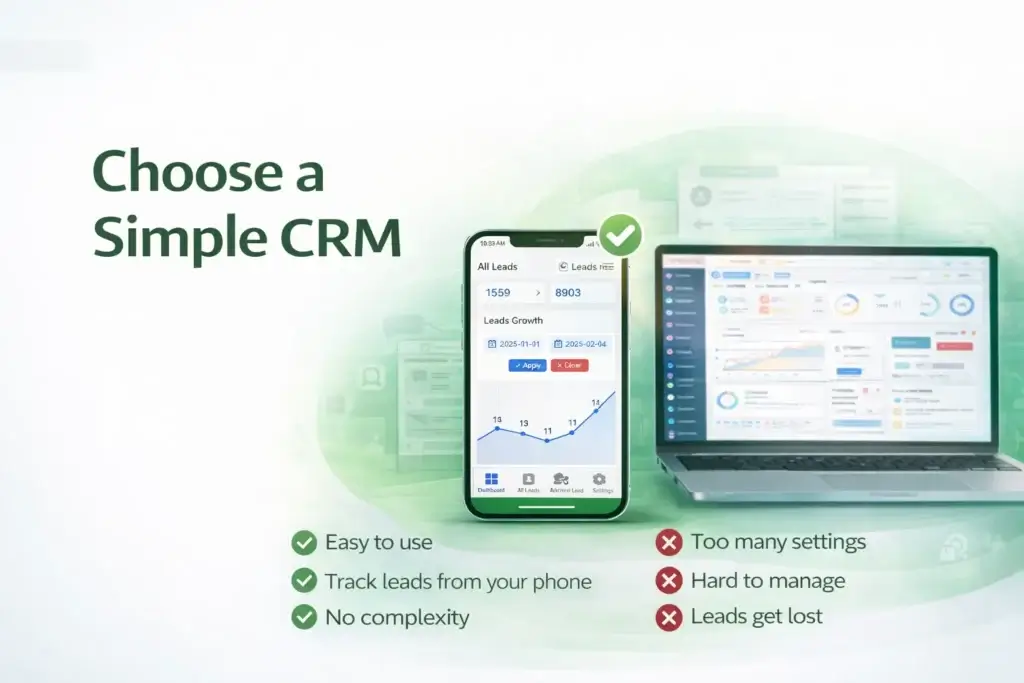
Not every business needs a complex system to grow.
In fact, for many small businesses and service providers, complexity becomes the biggest reason why a CRM fails not because the tool is bad, but because it is too difficult to use consistently.
A system that looks powerful on the surface often becomes a burden in daily use.
Complexity Feels Impressive Until You Use It
Many CRM tools are designed to offer everything at once.
They include:
- advanced automation
- deep customization
- multiple dashboards
- layered configurations
At first, this creates a strong impression.
But once you start using them daily, the experience changes.
Simple tasks begin to take longer.
Navigation becomes confusing.
And instead of helping your workflow, the system starts slowing it down.
When a Tool Becomes a Burden
A CRM is supposed to make your work easier.
But when it is too complex, you may find yourself:
- avoiding it
- delaying updates
- skipping steps in the process
This leads to inconsistency.
And inconsistency is one of the biggest reasons businesses lose control over their leads.
Most Businesses Only Need the Essentials
A common misunderstanding is that more features automatically mean better performance.
In reality, most businesses only need a few things done well:
- capturing leads
- organizing them clearly
- following up on time
- tracking progress
When a system focuses on these core functions, it becomes easier to use and more effective.
Everything else is secondary.
Simplicity Improves Daily Usage
The biggest advantage of a simple CRM is not just ease — it is usability.
When something is simple:
- you use it every day
- your team understands it quickly
- your process becomes consistent
This consistency is what drives real results.
A simple system that is used regularly will always outperform a complex system that is used occasionally.
Faster Adoption Across Your Team
For businesses with teams, simplicity becomes even more important.
A complicated system requires:
- training
- onboarding time
- continuous support
But a simple system allows your team to:
- start using it immediately
- understand it naturally
- stay aligned without confusion
This reduces friction and improves productivity.
Clear Systems Lead to Clear Decisions
When your CRM is clean and easy to understand, your data becomes more useful.
You can quickly see:
- which leads need attention
- what stage each lead is in
- where your opportunities are
There is no overload of unnecessary information — just clarity.
And clarity leads to better decision-making.
Simplicity Creates Momentum
When your system is easy to use, your workflow becomes faster.
You don’t hesitate to update leads.
You don’t delay follow-ups.
You don’t avoid using the tool.
Instead, your process keeps moving.
This momentum is what turns leads into conversions.
A Practical System for Real Businesses
A CRM should work for real-world scenarios.
It should support:
- small teams
- growing businesses
- service providers
- agencies
Not just large organizations with dedicated technical resources.
When a tool is built for real usage, it becomes part of your daily operations instead of an extra task.
Simplicity Is a Competitive Advantage
In a competitive market, speed and consistency matter more than complexity.
A simple system helps you:
- respond faster
- stay organized
- manage leads effectively
This gives you an edge over businesses that are stuck managing complicated tools.