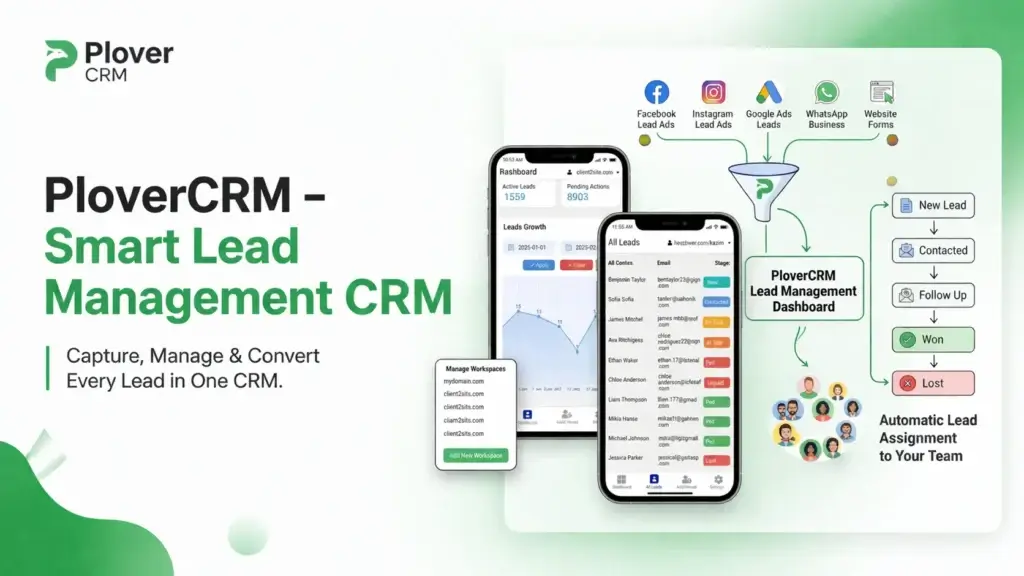
In today’s digital world, getting leads is no longer the difficult part.
The real challenge begins after a lead enters your business.
Customers now interact with businesses across multiple platforms. One might message you on WhatsApp, another might come through a Facebook ad, while someone else fills out a form on your website. At first, this feels like growth. More platforms, more opportunities.
But very quickly, this turns into something else disorganization.
Leads Are Coming From Multiple Directions
Your business is no longer operating from a single channel. Instead, your leads are scattered across different sources:
- Social media platforms
- Messaging apps
- Website forms
- Paid advertising campaigns
Each platform works independently, and none of them are designed to give you a complete picture of your leads.
This creates a situation where information is fragmented. You don’t see everything in one place, and that lack of visibility starts affecting how you respond to potential customers.
When There Is No System, Things Start Breaking
Without a proper system, even simple tasks become difficult.
You might forget to reply to an important message.
A lead might get lost in a long chat thread.
Someone on your team may assume another person has already followed up.
These are not big mistakes individually, but together they create serious problems.
A business without a structured lead management system often experiences:
- Delayed responses
- Missed follow-ups
- Duplicate communication
- Confusion within the team
Over time, these issues directly impact your conversions.
The Hidden Cost of Poor Lead Management
Most businesses don’t realize how much they are losing due to poor organization.
It’s not always visible. There is no notification telling you that a lead was missed. There is no alert saying a customer lost interest because you replied too late.
But the impact is real.
Every missed follow-up is a missed opportunity.
Every delayed response reduces your chances of closing a deal.
Every disorganized interaction weakens your overall sales process.
This is where growth silently slows down.
Adding More Tools Doesn’t Solve the Problem
Many businesses try to fix this by adding more tools.
They start using spreadsheets to track leads.
They connect forms with automation tools.
They add external CRMs to store data.
But instead of simplifying the process, this often makes it more complicated.
Now you’re not just managing leads you’re managing tools.
Switching between multiple platforms, dealing with syncing issues, and trying to keep everything updated becomes a task in itself.
What Businesses Actually Need
At its core, lead management should be simple.
You should be able to:
- See all your leads in one place
- Know exactly where each lead stands
- Follow up without delays
- Keep your entire team aligned
A proper system should reduce complexity, not add to it.
The Real Problem Isn’t Leads It’s the System
The truth is, most businesses don’t struggle with getting leads.
They struggle with managing them.
When your leads are everywhere, but your system isn’t, growth becomes inconsistent.
And until that system is fixed, scaling becomes difficult.